How Judit Polgár played blindfold chess at age seven
Judit Polgár played chess blindfold at 7 and was a grandmaster at 15. Her blindfold results, what she says about patterns, and a drill to try.
Researched and drafted with AI assistance from the sources listed below. Every fact was checked against those sources before publication.
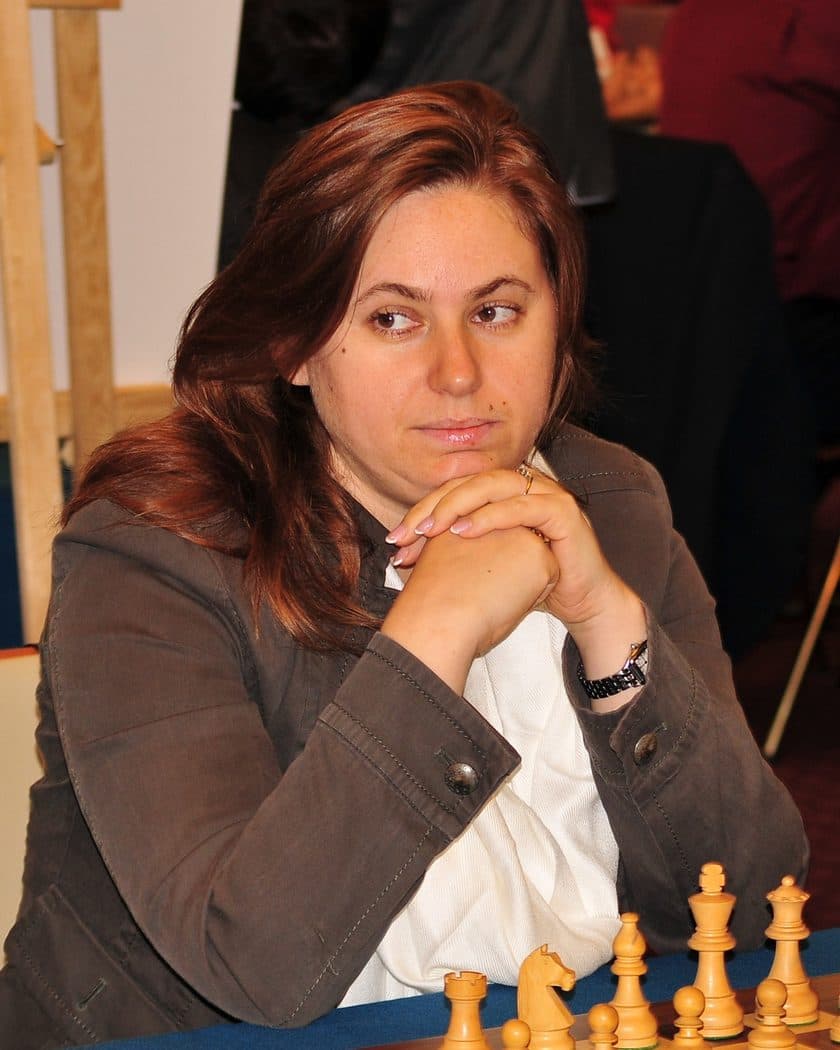
Fact file
- Born
- 23 Jul 1976, Budapest, Hungary
- Country
- Hungary
- Title
- Grandmaster, 1991
- Peak rating
- 2735 (2005)
- Known for
- Only woman ranked in the world top ten
- Memory feat
- Won blindfold games against adults at age 7
Seven years old, with no board
In the 1980s Herman Grooten, a Dutch trainer who holds the International Master title, stayed with the Polgár family in their Budapest apartment. Someone suggested blindfold chess, and Grooten assumed he would be the one playing without a board. He was wrong. The player without a board was Judit Polgár, who was 7.
Grooten told the story in a 2025 ChessBase column. He insisted on playing blind too. Chairs were set back to back and a clock was used. He blundered his queen and lost. For the second game he took a board. Judit still had none, and he lost again.
A history of blindfold chess by Eliot Hearst and John Knott, citing a 1992 book, mentions two blindfold games from Budapest in 1984. Sofia and Judit, then 9 and 7, won them. Their opponents were masters who also played blindfold. The girls complained that one opponent took too long to think and suggested a clock. Whether this is the visit Grooten describes is not clear.
Polgár's own explanation is plain. In 2025 she posted a passage that she credits to her book How to Become a Champion. In it she says it was important to know the 64 squares. She lists what each one is called, where it sits, and whether it is light or dark. With that knowledge, she wrote, "I could play blindfold chess as a child around age 7."
The rack of small positions
Her father, László Polgár, schooled his three daughters at home and made chess their specialty. Grooten saw a rack of chess diagrams in the girls' bedroom, and László changed the diagrams every week. Each position had relatively few pieces. László looked especially for problems that drilled checkmating patterns. Grooten writes that the diagrams were designed to train memory.
Hearst and Knott describe a recall exercise from the sisters' early training. The girls examined a position for 20 to 30 seconds. Then the position was removed and they had to reproduce it. Blindfold chess and speed chess were an important part of that training. By the age of 5 or 6, the authors write, all three sisters could play full games blindfold at fast time limits.
Polgár has tied exercise work to what she sees at the board. In her book How I Beat Fischer's Record she wrote that solving thousands of exercises makes mating combinations much easier to spot. "Pattern recognition is essential for a chess player," she told the magazine 032c in 2021.
Her results came early. On the January 1989 rating list she was 12 years old and number 55 in the world. In December 1991 she earned the grandmaster title at 15 years and 4 months. That broke a record Bobby Fischer had held for 33 years. She entered the top ten in January 1996. Her rating peaked at 2735 on the July 2005 list, where she ranked eighth. No other woman has been ranked in the top ten.
Blindfold against grandmasters
In 1993, at 16, she played the Melody Amber tournament in Monaco, which included a blindfold tournament of 12 grandmasters. She scored 6.5 points from 11 rounds and finished fourth, behind Viswanathan Anand, Anatoly Karpov and Ljubomir Ljubojević. Vasyl Ivanchuk, Nigel Short, Viktor Korchnoi and her sister Susan finished below her.
She was back at Amber in 1994. In the blindfold section she beat Ljubojević with the black pieces in a game of 106 moves. Her 83rd move left her with a king, a bishop and a knight against a lone king. The game record at Chessgames.com ends after White's 106th move. In the final position the white king is in a corner and she has checkmate on her next move.
Later blindfold events took her to Bilbao. In December 2006 she played a six-game match of blindfold rapid chess there against Veselin Topalov. She lost by 3.5 to 2.5. At the Blindfold World Cup in October 2007 she finished fourth of six players. One of her wins was against the tournament winner, Bu Xiangzhi. It was his only loss.
What research says about patterns
Polgár's account is about knowing the board. Research on blindfold play also points to knowledge. Alfred Binet questioned well-known players in 1893. He found that skilled players did not encode how the pieces and board looked, such as their color or style. They kept a more abstract representation. About a century later Pertti Saariluoma tested players on dictated games. He concluded that knowledge in long-term memory, more than imagery ability, accounts for differences in skill.
Recall experiments point the same way. Adriaan de Groot's masters could rebuild a game position almost perfectly after viewing it for a few seconds. Weaker players could not. William Chase and Herbert Simon repeated the test for a paper published in 1973. They used one master, one Class A player and one beginner. On middle-game positions of 24 to 26 pieces the master placed about 16 correctly on the first try. The Class A player placed about 8 and the beginner about 4. When the pieces were placed at random, playing strength made no difference in their study. Later experiments found a small edge for stronger players.
Chase and Simon explained the gap with chunks, familiar groups of pieces that are stored as single items. They began from the idea that a master holds about five chunks of four or five pieces. In their data the master recalled larger chunks than the weaker players, and more of them.
Those recall tests were run before Polgár was born, and no study cited here reports testing her. What follows is a reading of her training, not a research finding. László's rack can be seen as a weekly supply of chunks. A child who drills small mating patterns until each is familiar, and who knows every square by name, may have less to picture and more to recognize. Polgár's remarks about exercises and pattern recognition fit that reading.
Try it with 6 pieces and 5 seconds
In Memory Chess, set a round to 6 pieces with 5 seconds to memorize. Six pieces make a small position, like the diagrams on László's rack. Five seconds is the viewing time Chase and Simon used, and it is far shorter than the 20 to 30 seconds the sisters had. While the board is showing, use the knowledge Polgár lists. Name each occupied square and note whether it is light or dark. When the board clears, say the list once from memory, then place the pieces. After three clean rounds in a row, add two pieces and keep the 5 seconds.
Sources
- Understanding before Moving 215: Judit Polgar, Herman Grooten, ChessBase, February 2, 2025
Supports: Grooten's stay with the family in the 1980s, his two blindfold games against 7-year-old Judit, the back-to-back chairs, the clock, the blundered queen, the rack of diagrams changed weekly, the few-piece checkmating positions meant to train memory, homeschooling with chess as the specialty, Grooten's title.
- Post by Judit Polgár on X, May 30, 2025, quoting her book How to Become a Champion
Supports: the 64 squares passage and the direct quote about playing blindfold around age 7.
- Blindfold Chess: History, Psychology, Techniques, Champions, World Records, and Important Games, Eliot Hearst and John Knott, McFarland, 2009, page 137
Supports: the two blindfold games won in Budapest in 1984 by Sofia and Judit at 9 and 7, the blindfolded master opponents, the complaint about slow play and the clock, the 20 to 30 second recall exercise, blindfold and speed chess in the sisters' early training, full blindfold games at 5 or 6.
- Judit Polgár, Wikipedia
Supports: birth date and place, number 55 on the January 1989 list at age 12, the grandmaster title in December 1991 at 15 years and 4 months, Fischer's 33-year record, number 10 in January 1996, peak rating 2735 in July 2005, the only woman in the top ten, fourth place with 6.5 of 11 in the 1993 Amber blindfold tournament and the players she finished behind and ahead of, the Bilbao results of 2006 and 2007.
- Top 100 Players July 2005, FIDE, archived
Supports: rating 2735 and rank 8 on the July 2005 list.
- Book Review: "How I Beat Fischer's Record" by GM Judit Polgar, Daniel Rensch, Chess.com, March 26, 2013
Supports: Polgár's statement that solving thousands of exercises makes mating combinations easier to spot.
- The Aggressive Attacker: An Interview with Chess Grandmaster Judit Polgár, Shane Anderson, 032c, November 23, 2021
Supports: the pattern recognition quote.
- Ljubomir Ljubojevic vs Judit Polgar, Melody Amber blindfold, 1994, Chessgames.com
Supports: her 1994 Amber blindfold win with Black in 106 moves, the bishop and knight ending after her 83rd move, the final position.
- Perception in chess, William Chase and Herbert Simon, Carnegie Mellon preprint of the 1973 Cognitive Psychology paper
Supports: de Groot's finding from a few seconds of viewing, the three players, middle-game positions of 24 to 26 pieces, about 16, 8 and 4 pieces placed, the random boards, the starting hypothesis of about five chunks of four or five pieces, the result that the master recalled more chunks and larger chunks.
- Recall of rapidly presented random chess positions is a function of skill, Fernand Gobet and Herbert A. Simon, Psychonomic Bulletin and Review 3, pages 159 to 163 (1996)
Supports: the small advantage stronger players keep on random positions.
- The mind's eye in blindfold chess, Guillermo Campitelli and Fernand Gobet, European Journal of Cognitive Psychology, 2005, author preprint
Supports: Binet's 1893 questionnaire and abstract representation, Saariluoma's 1991 experiments with dictated games, long-term memory knowledge and not imagery ability as the source of skill differences, the 1973 date of the Chase and Simon paper.